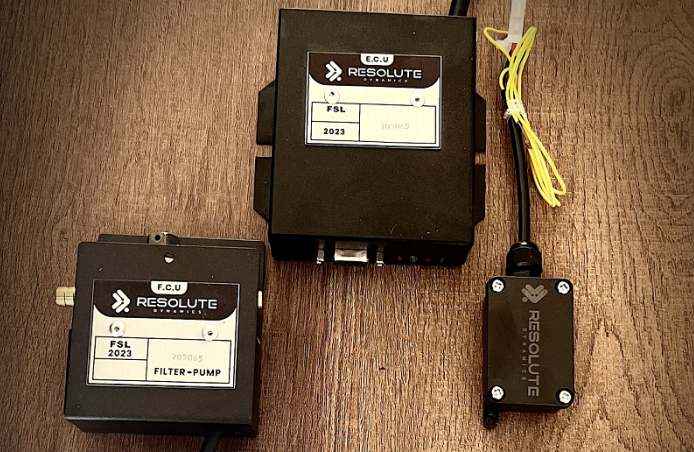
Most guides to Gulf speed limiter rules make the same mistake. They treat the GCC as one market with one rulebook, then list six countries as though each carries an identical obligation. That framing is comfortable. It is also wrong, and it costs fleets real money in both directions — some over-buy compliance they do not owe, others assume a certificate earned in one country is good in the next and discover otherwise at a border.
Here is the distinction that everything else hangs off:
A type-approval requirement says: if you fit a device, it must meet this specification, and it must be certified before it enters the country. A fitment mandate says: you must fit one.
These are not the same thing. The Gulf has a broadly harmonised answer to the first. It has six different answers to the second.
Get that clear and the rest of the region becomes navigable. Miss it and every comparison table you read will mislead you.
The harmonised layer: three GSO standards
The technical specification for a speed limiter is regional, and it is the one genuinely shared thing across the GCC. Three Gulf Standardization Organization standards define what a compliant device has to be and do.
| Standard | What it governs |
|---|---|
| GSO 1625:2002 | General requirements and performance. How the device caps maximum speed, how it integrates with the engine and fuel system, and how reliably it holds the set limit. |
| GSO 1626:2002 | Test methods. How the device is actually put through its paces to prove it meets 1625. |
| GSO 1711:2005 | Inspection, certification and type approval. The general requirements for how a speed limiter gets officially blessed for motor vehicles. |
The logic runs in sequence. 1625 says what the device must be. 1626 says how you test it. 1711 says how it gets approved. Together they form the technical spine that national certification schemes rest on.
The GSO is headquartered in Riyadh, which keeps Saudi Arabia tightly aligned with the wider Gulf rulebook and gives the Kingdom disproportionate gravity in how the standards evolve.
Member states adopt these standards into their own frameworks — which is why the device sitting in a Kuwaiti truck and the device in a Bahraini one are answering to the same underlying spec.
What harmonisation buys you — and what it doesn’t
It is worth being precise about the limits here, because “GSO-compliant” gets thrown around as though it were a passport.
What it does buy you: a device that is technically acceptable across the region. You are not designing six different products. A limiter engineered to GSO 1625 and tested to GSO 1626 has the right electrical characteristics, the right tamper resistance, the right speed-holding behaviour, wherever it ends up.
What it does not buy you: the right to sell it, import it, or fit it. Each country runs its own approval, its own certificate, its own inspection cycle, and its own list of recognised bodies. GSO gets your device to the door. It does not open it.
This is the single most misunderstood point in Gulf fleet compliance, and it is where most of the avoidable expense lives.
Where fitment is genuinely mandatory: the UAE
The UAE runs the strictest regime in the Gulf and is the clearest case of an actual fitment mandate rather than a type-approval requirement.
Which vehicles are in scope
Speed limiters are required across a defined set of commercial and passenger classes:
- Heavy goods vehicles over 3.5 tonnes
- Commercial buses
- School transport
- Taxis
- Logistics and courier vans
- Construction and waste-management vehicles
Private cars, motorcycles and most emergency vehicles sit outside the core requirement, though full exemption lists come from the federal authorities rather than the emirate-level bodies.
The working rule of thumb: if the vehicle moves goods or people for money, assume it is in scope until you confirm otherwise.
The emirate split that catches operators out
This is the part people get wrong most often. Many operators assume the Dubai-based Roads and Transport Authority runs the whole country. It does not.
- Dubai runs speed limiter approvals through the Roads and Transport Authority (RTA).
- Abu Dhabi runs them through Abu Dhabi Mobility — formerly the Integrated Transport Centre (ITC), operating under the Department of Municipalities and Transport — with its own digital layer, ASATEEL, tying certificates to live monitoring.
The certificate concept is recognised nationwide for inspection purposes. But the enforcement body and the digital systems are emirate-specific, and a vehicle operating in Abu Dhabi must still satisfy Abu Dhabi’s ITC and ASATEEL requirements regardless of where its paperwork was issued.
Speed settings and the Abu Dhabi buffer
Heavy trucks are commonly capped around 80 km/h on highways. Buses and minibuses sit around 100 km/h. The exact figure is decided by vehicle category and the posted limit, not by operator preference.
One distinction matters more than any other for drivers: Abu Dhabi applies no speed buffer. In most emirates there is roughly a 20 km/h cushion above the posted limit before a camera fines you. In Abu Dhabi the number on the sign is the number enforced — 1 km/h over an 80 km/h limit and the radar can flag it.
That zero-tolerance design is precisely why a correctly calibrated limiter earns its keep there. It keeps drivers compliant without them having to watch the speedometer continuously.
What non-compliance actually costs
The penalty rarely lands in one place. A single failed inspection can trigger a fine, block registration renewal, and leave a vehicle idle for weeks. For a logistics operator running tight delivery windows, the lost operating time typically hurts more than the fine.
Calibration locks the device to the threshold the authority approves for that vehicle class. A technician sets the cap, road-tests it, then seals the connection so the setting cannot be quietly raised later. Roadside inspections add an unscheduled layer on top of the annual test — which is why “I’ll fix it before the next inspection” is a poor strategy.
Full detail sits in our UAE speed limiter rules guide, and for the emirate-level breakdown, Abu Dhabi speed limiter certification and ITC transport rules.
Saudi Arabia: type approval, not a blanket fitment mandate
This is the section most comparison guides get wrong — including the earlier version of this one.
Saudi Arabia requires speed limiter compatibility and certification at the point a device enters the Kingdom. It does not, as of mid-2026, impose a blanket nationwide requirement that every commercial vehicle have a limiter fitted and active on the road.
That distinction has real financial consequences, and conflating the two has led operators to make purchasing decisions on a legal premise that does not hold.
Here is what is in place.
The law
Road transport in Saudi Arabia is governed by the Road Transport Law, issued as Royal Decree No. M/188 in 2025. This is the instrument that sets the framework for commercial road transport activity in the Kingdom.
The regulators
Oversight belongs to the Transport General Authority (TGA). Not the “Public Transport Authority” — that is an obsolete name still circulating widely in secondary sources and in a great many comparison articles. TGA regulates land, rail and maritime transport, licenses carriers, sets operational standards, and supervises compliance mechanisms for commercial fleets.
Enforcement on the street comes from the Ministry of Interior (MOI), through its General Department of Traffic.
Device certification is a separate track entirely, and it runs through SASO. More on that below, because it is the part that actually affects anyone buying hardware.
The monitoring layer: Wasl
Wasl, operated under TGA, registers commercial vehicles and drivers, monitors fleet activity, and ties operators into the Kingdom’s road-safety oversight. It is where telematics, vehicle tracking and operating permits converge.
This matters for hardware selection. Saudi already supervises fleets through a digital, connected layer — which is why a GPS-enabled limiter pairs far more naturally with the Saudi compliance model than a standalone mechanical unit would. The device that only caps speed does its job. The device that caps speed and reports is speaking the language the regulator already uses.
Why fleets are fitting them anyway
Vision 2030 is pulling speed limiters into the mainstream in Saudi Arabia even without a hard mandate. The Kingdom’s road-safety targets, the logistics demands of its mega-projects, and its drive to cut traffic fatalities all point the same direction.
Large logistics operators, school transport providers and oil-and-gas contractors are fitting limiters ahead of any legal requirement — because it lowers insurance exposure, protects drivers, and reads well against national safety goals. In the oil and gas sector in particular, the contractual requirement from the client typically arrives long before the regulatory one from the state.
The direction of travel is not ambiguous. Getting ahead of it is cheaper than scrambling later.
How SASO and SABER actually work
If you are importing or specifying a speed limiter for Saudi Arabia, this is the process you will actually go through. It is worth understanding properly, because the failure modes are procedural, not technical — devices rarely fail on their engineering; applications fail on their paperwork.
The three names, and what each one is
People use these interchangeably. They are not interchangeable.
- SASO — the Saudi Standards, Metrology and Quality Organization. The national standards body. SASO writes the rules.
- SALEEM — the Saudi Product Safety Programme. The framework of technical regulations SASO issues. SALEEM is the law.
- SABER — the electronic platform (saber.sa) launched to administer the programme. SABER is where you prove you follow the law.
When someone says they “need SASO certification for a speed limiter,” what they actually mean is that they need to pass conformity assessment on SABER under a SALEEM technical regulation, against the GSO standards above.
The two certificates
The system issues two documents, and you need both.
| Certificate | Scope | Validity |
|---|---|---|
| PCoC — Product Certificate of Conformity | Per product model | One year from issue |
| SCoC — Shipment Certificate of Conformity | Per consignment | That shipment only |
A PCoC alone does not clear customs. Every individual shipment needs its own SCoC, even when you already hold a valid PCoC for the product. The SCoC verifies that this particular batch conforms to what the PCoC certified.
The process, step by step
1. Classify the product by HS code. This is the step that quietly decides everything downstream. The HS code determines which SASO technical regulation applies, which determines which standards you are tested against. Get the classification wrong and you are assessed against the wrong standards — which is automatic non-compliance. More applications die here than anywhere else.
2. Appoint a Conformity Assessment Body (CAB). You cannot self-certify a regulated product. You must select a SASO-approved CAB from the list of notified bodies and submit through them. The CAB acts as the independent third party across the whole assessment.
3. Assemble the technical file. Typically: product specifications, test reports from an accredited laboratory, an ISO 9001 certificate for the manufacturing site, a Supplier Declaration of Conformity, and product photography. Requirements scale with the product’s risk classification.
4. Testing — and the ISO 17025 shortcut. Test reports from an ISO 17025-accredited laboratory anywhere in the world can be submitted to the CAB for verification, without necessarily resorting to additional local testing. There is a condition attached: the test report should be less than three years old at the point of submission. An old report is a rejected report, and re-testing is where the timeline balloons.
5. PCoC issued. The CAB reviews the file, may request clarifications or conduct a physical inspection depending on risk classification, and — if compliant — issues the Product Certificate of Conformity. Valid for one year.
6. SCoC per shipment. Before each consignment, the importer applies for a shipment certificate, presenting the commercial invoice. The SCoC is what Saudi customs actually wants to see.
The trap almost everyone falls into
The PCoC is importer-specific. It must be issued under the name of the Saudi-based Importer of Record.
Two consequences follow, and both bite:
- Exporters cannot register directly on SABER. You must work through a Saudi importer or authorised representative. If you are a manufacturer planning to ship direct, that plan does not exist.
- Change your importer and the certificate does not travel with you. The PCoC is tied to that entity. Switch distributor and you are re-certifying, not transferring.
Fleets that discover this at the point of import lose weeks. Fleets that discover it at the point of switching supplier lose more.
If you want the certification path laid out end to end, that is the subject of Saudi Arabia speed limiter SASO certification for commercial vehicles. For hardware and fitment, see our speed limiter device in Saudi Arabia page.
The rest of the Gulf: check nationally, do not assume
Oman, Qatar, Kuwait and Bahrain all sit on the same GSO technical foundation. What differs — and differs materially — is whether fitment is legally compelled, for which vehicle classes, and how it is enforced.
We are not going to hand you a confident one-line mandate status for each of these, because the honest answer is that it varies by vehicle class, by sector and by year, and the secondary sources on the subject contradict one another.
A comparison table that asserts six clean mandates is a table someone invented. We would rather tell you where to look than tell you something tidy and wrong.
What we can say with confidence:
Sector rules frequently bind before national rules do. This is the pattern that repeats across the Gulf, and it is the one operators consistently under-weight.
- Oman — the clearest example. Oil-and-gas contractors working to PDO and OPAL standards face multi-speed limiter requirements that go well beyond anything in general traffic law. A contractor can be fully compliant with Omani road law and still be barred from a site. See Oman’s MSLD and OPAL rules and our Oman page.
- Qatar — Qatar speed limiter laws: full compliance guide and the Qatar page.
- Kuwait — Kuwait speed limiter regulations and the Kuwait page.
- Bahrain — Bahrain speed limiter compliance: what fleets need to know and the Bahrain page.
If you move tankers or oil-field vehicles across the region, the sector layer is the one to plan around first. That is set out in speed limiter requirements for tanker and oil-field vehicles in the GCC.
The mistake that costs cross-border fleets the most
A SASO certificate and a Dubai RTA certificate are not interchangeable.
They are not two versions of the same document. They are two different regimes that happen to sit on the same technical standard.
| Saudi Arabia | UAE | |
|---|---|---|
| Approval route | SASO, via the SABER platform, under SALEEM | RTA (Dubai) / Abu Dhabi Mobility (Abu Dhabi) |
| Technical basis | GSO 1625 / 1626 / 1711 | Authority-approved device list |
| Certificate | PCoC (per product, 1 yr) + SCoC (per shipment) | Speed limiter certificate, tied to inspection cycle |
| Who holds it | Saudi-based Importer of Record | Vehicle owner / operator |
| Installer network | CAB-assessed product; fitment separately arranged | Authority-approved installer network |
| Digital layer | Wasl (TGA) | ASATEEL (Abu Dhabi) |
A device certified in Dubai is not automatically blessed in Riyadh. A fleet crossing the border cannot assume one piece of paper covers both. Operators find this out at customs, or at inspection, and by that point the vehicle is already stationary and the cost has already been incurred.
The practical implication: if you run cross-border, buy hardware capable of satisfying multiple approval routes, and budget for parallel certification. Not one certificate. Several.
What operators should actually do
1. Establish mandate status per country, per vehicle class — in writing, from the national authority. Not from a comparison article. Including this one. The regulatory position moves, and the cost of being wrong is a stationary vehicle.
2. Separate “type approval” from “fitment mandate” in your own planning. Ask two questions of every country you operate in, not one. Must I fit a device? and If I do, what does it have to be certified against? The answers are different, and in Saudi Arabia’s case they currently point in different directions.
3. Stop treating “GSO-compliant” as “legal everywhere.” GSO makes your device technically acceptable. It does not make it approved. That is a national step, every time.
4. Sort your HS classification before anything else. If you are importing into Saudi Arabia, the HS code decides which technical regulation you are assessed under. Everything downstream inherits that decision. Get a CAB to confirm it before you spend money on testing.
5. Check the age of your test reports. An ISO 17025 report from anywhere in the world is acceptable — but not if it is over three years old. Audit your documentation before you start a SABER application, not during.
6. Map your sector obligations, not just your national ones. If you serve oil and gas, mining, or public transport, the client contract will often impose a stricter limiter requirement than the state does, and it will arrive sooner.
7. Watch Saudi Arabia. The absence of a blanket mandate today is not a prediction about tomorrow. Vision 2030’s road-safety agenda, the fatality-reduction targets, and the existing Wasl monitoring infrastructure all point one way. The Kingdom already has the surveillance layer in place. Adding an obligation to it is a policy decision, not an engineering one.
Frequently asked questions
Are speed limiters mandatory across the whole GCC?
No. The GCC shares a common technical standard for the device — GSO 1625, 1626 and 1711 — but fitment mandates are national and they differ. The UAE has the clearest mandatory regime. Saudi Arabia requires limiter certification at the point of import without imposing a blanket nationwide fitment requirement as of mid-2026.
Does a Dubai RTA speed limiter certificate work in Saudi Arabia?
No. Saudi approvals run through SASO and the SABER platform under the SALEEM programme. The certificates are not interchangeable, and holding one does not shorten the process for the other.
Who regulates speed limiters in Saudi Arabia?
The Transport General Authority (TGA) oversees road transport under the Road Transport Law (Royal Decree No. M/188, 2025). Enforcement comes from the Ministry of Interior’s General Department of Traffic. Device certification runs through SASO, via the SABER platform.
What is the difference between SASO, SALEEM and SABER?
SASO is the standards authority — it writes the rules. SALEEM is the product safety programme — the technical regulations themselves. SABER is the online platform where you register the product and obtain your certificates. SASO owns all three.
How long is a SASO speed limiter certificate valid?
A Product Certificate of Conformity (PCoC) is valid for one year from issue. A Shipment Certificate of Conformity (SCoC) is issued per consignment and covers only that shipment.
Can I use test reports from a lab outside Saudi Arabia?
Yes. Test reports from an ISO 17025-accredited laboratory anywhere in the world can be submitted to the Conformity Assessment Body for verification. The report should be less than three years old at the point of submission.
Can an exporter register directly on SABER?
No. SABER registration must be done through a Saudi-based importer or authorised representative, and the PCoC is issued under the Importer of Record’s name. Changing importer means re-certifying.
What speed are heavy vehicles capped at in the UAE?
Heavy trucks are commonly capped around 80 km/h on highways and buses around 100 km/h, with the exact setting determined by vehicle category and the posted road limit.
Which GSO standards apply to speed limiters?
GSO 1625:2002 (general requirements and performance), GSO 1626:2002 (test methods), and GSO 1711:2005 (inspection, certification and type approval).
Does Abu Dhabi have a speed buffer?
No. Most emirates allow roughly 20 km/h above the posted limit before enforcement. Abu Dhabi does not — the posted number is the enforced number.
For fleet operators managing vehicles across multiple GCC countries, our speed limiter product range supports the various per-country calibration requirements. See also the country deep-dives for Oman, Zimbabwe, and India.

The Resolute Dynamics team designs and manufactures speed limiters (SLD), GPS tracking, and automotive safety systems used on 200,000+ vehicles across 20+ countries. We write about fleet compliance, road-safety regulation, and vehicle-safety technology, including Malaysia’s JPJ SLD mandate, UAE RTA rules, and global standards like UN R89, to help fleet operators and transport businesses stay safe and compliant.