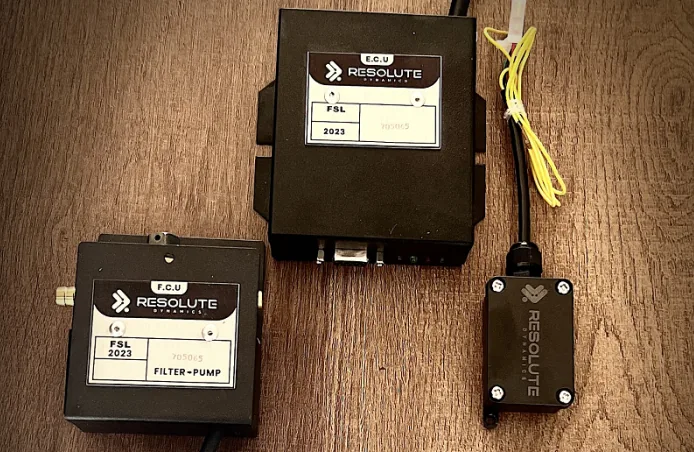
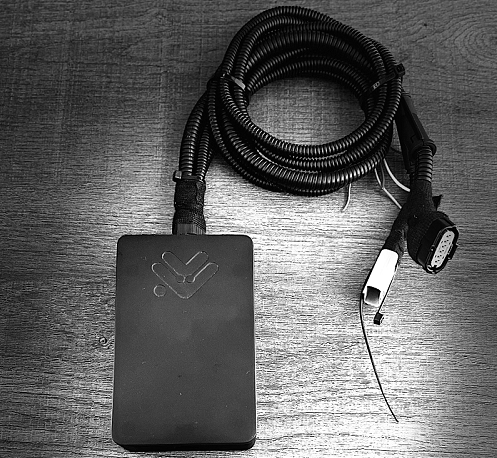
If you have ever been handed a type approval certificate and wondered what actually happened inside the lab to produce it, this is the walkthrough. AIS-018 is not a long standard, but it is a specific one — it tells you exactly how many samples ARAI wants, what temperature the salt spray chamber runs at, and how many kilometres per hour of drift the test agency will tolerate before it fails your unit.
Two documents do the work here. CMVR Rule 118 decides whether a vehicle must be fitted. AIS-018 decides whether the thing you fitted is legal. People collapse these into one idea and then get confused when a device passes one and fails the other.
If you are past the regulation and into procurement, our speed limiter device in India page covers models, fitment and certification support. Everything below is the standard itself.
AIS-018 is the standard a speed limiter has to be tested against before it can be fitted
AIS-018:2001, titled Automotive Vehicles – Speed Limitation Devices – Specifications, sets out the requirements, the methods of test, and the type approval procedure for speed limiters used on Indian vehicles.
It is published by ARAI on behalf of the Automotive Industry Standards Committee, which sits under the CMVR Technical Standing Committee set up by the Ministry of Road Transport and Highways. So although you will hear people call it “the ARAI standard,” ARAI is the printer and one of the test agencies — the authority behind it is MoRTH.
The standard has been amended five times. Amendment No. 5, issued 19 December 2017, is the most recent and added an EMC requirement. That matters more than it sounds like it should, and I will come back to it.
Rule 118 is what makes fitment compulsory
The introduction to AIS-018 says it plainly: under CMVR Rule 118, transport vehicles notified by the Central Government must be fitted with a speed governor.
Rule 118 was amended by MoRTH notification G.S.R. 290(E) dated 15 April 2015. That amendment put the fitment obligation on the vehicle manufacturer, at either the manufacturing stage or the dealership stage.
Sub-rule (2) then hands State Governments a separate power — they can notify categories of transport vehicles registered before 1 October 2015 that were never fitted, and require the operator to retrofit them.
This is why compliance responsibility feels split in practice. New vehicle, factory-fitted, manufacturer’s problem. Older vehicle, retrofit, your problem.
Preset speeds are either 80 km/h or 60 km/h, and the category decides which
The preset speed is not something a fleet chooses. It is fixed by category. State transport departments reproduce the central position in their retrofit orders — the West Bengal Transport Department’s notification No. 2-WT/3M-75/2013, dated 4 January 2016, lists them like this:
| Preset speed | Vehicle categories |
|---|---|
| 80 km/h | Stage carriages; contract carriages, maxi cabs, private service vehicles, omnibuses (transport) and tourist vehicles of M1/M2/M3 category with seating capacity above eight passengers plus driver and gross vehicle weight above 3,500 kg; goods carriages excluding three-wheelers; transport vehicles certified by a Rule 126 testing agency as having a maximum rated speed of not more than 80 km/h |
| 60 km/h | Dumpers; tankers; school buses; transport vehicles carrying hazardous goods |
Two things worth noticing. The seating-capacity threshold and the 3,500 kg weight threshold apply together, not separately — a bus with nine seats and a 3-tonne GVW is not caught by that clause.
And school buses sit in the 60 km/h bracket alongside tankers and hazardous cargo, which tells you something about how the framework thinks about consequence rather than vehicle size. If you run school transport, our note on school bus speed limiter testing frequency goes into the inspection side of that.
AIS-018 covers two different things, and confusing them will cost you a test cycle
Amendment No. 2 split the subject in two:
- SLD (Speed Limitation Device) — a device whose primary function is to control the fuel feed to the engine in order to limit vehicle speed to a specified value. It can be a separate unit fitted to the vehicle, or an on-board system built into it.
- SLF (Speed Limiting Function) — a function that controls the fuel feed or engine management to cap the vehicle at a fixed maximum. In practice, this is speed limiting written into the ECU software.
The distinction is not academic. Several AIS-018 tests are explicitly marked not applicable to SLF — the functional and power consumption test, the operating voltage range test, damp heat cycling, and the entire conditioning test block. You cannot put a software function in a salt spray chamber.
Where the SLF lives inside the engine management system, the manufacturer may skip the endurance block if it submits a signed declaration of compliance (Annexure 1) or the relevant test reports instead.
If you are still deciding which architecture to build around, how the ECU powers speed limiting and types of speed limiter devices both go deeper than I can here.
The test agency wants five samples, and only one of them ever sees a vehicle
AIS-018 requires five samples: four for bench performance and endurance testing, and one fitted to the vehicle for the on-road or dynamometer trials.
Performance tests
All four bench samples go through:
- Visual examination — workmanship, finish, marking, and the general requirements in Clause 4.
- Functional test and power consumption — the unit is coupled to a test rig and checked that it actually limits at the set value. Maximum current draw is recorded and must not exceed what the manufacturer declared.
- Operating voltage range — a 24 V unit must work between 22 V and 32 V; a 12 V unit between 11 V and 16 V. (The 6 V row was struck out by Amendment No. 2.)
Endurance tests
Each of the four samples takes a different beating. Post-Amendment-2 parameters:
| Test | Condition | Cycles |
|---|---|---|
| Ambient temperature | 30°C ± 5°C | 50,000 |
| High temperature | 65°C ± 5°C (electronic) / 100°C ± 5°C (mechanical) | 12,500 |
| Low temperature | −20°C ± 5°C | 12,500 |
| Salt spray | 5% sodium chloride, 35°C ± 2°C | 12,500 |
| Vibration | 10–24 Hz at ±2 mm amplitude, then 24–1,000 Hz at 2.5 g (chassis/cab-mounted) or 5 g (engine-mounted) | 1 hour per axis |
The −20°C floor surprises people who only think about Indian summers. It is there because the standard was aligned to European practice, not because of Ladakh.
The 100°C mechanical figure is the one that actually bites on engine-bay installations. We wrote separately about how speed limiters get engineered for India’s climate and road conditions, which is where these numbers stop being abstract.
If a device breaks during an endurance test, the manufacturer can request that a second unit be submitted for that specific test. That is a lifeline, not a loophole — it does not reset the whole programme.
Conditioning tests
Dust, contaminants, water spray, bump, and a drop-and-topple test from 200 mm, six drops. After all of it, the device still has to meet the functional test requirements. None of this applies to an SLF.
Tamper resistance is written into the standard as a design obligation
This is Clause 4.3, and it is the toughest paragraph in the document. The limitation threshold must not, under any circumstances, be capable of being increased or removed — temporarily or permanently — on a vehicle in use.
Meeting it is not a matter of asserting it. The manufacturer has to demonstrate “inviolability” to the test agency with documentation that analyses the failure modes of the system: what happens to the output if an input state changes, whether that change can be produced by a fault or by deliberate tampering, and how likely each is. The analysis runs to the first failure.
Clause 4.4 adds the physical layer — the device, and every connection it needs except those essential to running the vehicle, must be protected from unauthorised adjustment or power interruption using sealing devices and/or special tools. That is the legal basis for the seal an inspector looks for. Tamper-proof seals on speed governors covers what those actually are.
A few other Clause 4 requirements that get missed:
- The set speed must be shown on a plate in a conspicuous position in the driver’s compartment (Clause 4.14).
- The device must offer a functional check facility so field authorities can verify the set speed and confirm it is working (Clause 4.15).
- The limiter must not actuate the vehicle’s service braking system. A permanent brake or retarder may only engage after fuel feed has already been cut to minimum.
- No malfunction and no tampering may result in engine power rising above what the accelerator position is asking for.
- Since Amendment No. 5, the device must also meet the EMC performance requirements of AIS-004 (Part 3).
The track test is where approval is actually won or lost
Once the bench work is done, the fifth sample goes on a vehicle. There are two acceptable routes: a test track, or a chassis dynamometer. The supplier chooses.
On the track, the vehicle starts 10 km/h below the set speed, gets full accelerator, and holds it for at least 30 seconds after the speed stabilises. Speed is measured to ±1% accuracy, time to 0.1 seconds. Conditions are controlled: gradient not over 2%, varying by no more than 1%; mean wind under 6 m/s with gusts capped at 10 m/s.
The acceptance criteria are where the tolerances live:
| Parameter | Limit |
|---|---|
| Stabilised speed (V<sub>stab</sub>) | Must not exceed set speed (V<sub>set</sub>). Tolerance: 5% of V<sub>set</sub> or 5 km/h, whichever is higher |
| Peak speed after first reaching V<sub>set</sub> | Must not exceed V<sub>set</sub> by more than 5% |
| Rate of speed change (transient) | Not more than 0.5 m/s² |
| Time to reach stabilised conditions | Within 10 seconds of first reaching V<sub>set</sub> |
| Speed variation once stable | Not more than 4% of V<sub>set</sub>, or 2 km/h, whichever is higher |
| Rate of speed change (stable) | Not more than 0.2 m/s² |
There is a second track method too — the steady speed test. Full acceleration to a steady speed, hold it for at least 400 metres, repeat in the opposite direction, average the two.
Do the whole thing five times. The difference between the stabilisation speeds across those runs has to be 3 km/h or less. A device that limits accurately but inconsistently fails right here, and that is the failure mode nobody plans for.
Both track methods have to be verified for every gear ratio that would theoretically allow the speed limit to be exceeded — not just top gear.
The chassis dynamometer is a legitimate alternative
If track time is the constraint, the dynamometer route is accepted. Equivalent inertia has to be reproduced to ±10%, speed measured to ±1%, time to 0.1 seconds. The brake power is set to match the vehicle’s resistance to movement at the tested speed, or — at the manufacturer’s request — simply to 0.4 P<sub>max</sub>.
Acceleration runs start 10 km/h below set speed and hold for at least 20 seconds after stabilisation. The acceptance criteria are identical to the track.
Type approval does not end when the certificate is printed
Amendment No. 4, dated 16 May 2014, added a whole clause on this. The manufacturer must take all appropriate steps to ensure components continue to comply, in line with AIS-037:2004 — that is Conformity of Production.
And there is a rule about who does the paperwork: the Type Approval Certificate, the CoP documentation, the test reports and any extension reports must all be issued by the same agency that issued the original Type Approval. You cannot get approved by one agency and then have a cheaper one handle your extensions.
Changing the vehicle can invalidate the approval
Amendment No. 3 (August 2013) rewrote Clause 3.7 to define when an approval can be carried across to a different vehicle. The two vehicles must not differ in:
- Make and type of the SLD or SLF fitted
- Maximum engine power to unladen weight ratio (must be less than or equal to the tested vehicle)
- Set speed or set speeds
- Highest ratio of engine speed to vehicle speed in top gear (again, less than or equal to the tested vehicle)
- Method used to control fuel feed
- Fuel type
- Vehicle model and category
Every modification to the vehicle type must be reported to the test agency that approved it. The agency then either accepts that the change is unlikely to have any appreciable adverse effect, or demands a further report.
Fleets that change engine variants mid-order and assume the certificate travels with the device are the ones that get caught. Our guide on updating a speed limiter after regulatory changes is the practical companion to this.
Where AIS-018 came from
The standard was built by merging two older Indian standards — IS 10144:1982 (electronic speed limiters for diesel vehicles) and IS 14382:1996 (installed requirements) — and then aligning the result with European practice. AIS-018 explicitly names EC Directive 92/24/EEC and ECE R-89 as its basis.
That lineage is useful to know, because it means an AIS-018 device and a UN R89 device are cousins, not strangers. If you operate across borders, the global comparison of speed limiter laws and our note on ISO and SAE speed governor standards map the overlaps.
One last piece of housekeeping: AIS-018 and AIS-140 are different standards solving different problems. AIS-140 governs GNSS tracking and panic buttons. Most commercial fleets need both, and how AIS-140 and speed limiter compliance work together untangles them properly.
Frequently Asked Questions
Who can issue an AIS-018 type approval? A testing agency notified under Rule 126 of the CMVR. ARAI and ICAT are the two most commonly used. Under Amendment No. 4, whichever agency issues your Type Approval must also issue the Conformity of Production documents, test reports and extension reports.
Is AIS-018 the same as a speed governor certificate from an RTO? No. AIS-018 type approval is granted to the device (or the vehicle-plus-device combination) by a test agency. What an RTO checks during fitness inspection is that a compliant device is fitted, sealed and set correctly on your vehicle. Related reading: get your speed limiter certificate.
What tolerance does AIS-018 allow on the set speed? The stabilised speed must not exceed the set speed, but a tolerance of 5% of the set speed or 5 km/h — whichever is higher — is accepted. Once stable, the speed may not vary by more than 4% of the set speed or 2 km/h, whichever is higher.
Does a software-based limiter still need endurance testing? Not necessarily. Where the speed limiting function is built into the engine ECU, AIS-018 allows the endurance block to be omitted if the manufacturer demonstrates resistance to those effects — either through a signed declaration in the Annexure 1 format, or by submitting the relevant test reports.
How often does a fitted speed limiter need to be checked? AIS-018 governs approval, not in-service inspection intervals — those come from CMVR fitness requirements and state rules. See how often speed governors should be calibrated and calibration tools, frequency and standards.

The Resolute Dynamics team designs and manufactures speed limiters (SLD), GPS tracking, and automotive safety systems used on 200,000+ vehicles across 20+ countries. We write about fleet compliance, road-safety regulation, and vehicle-safety technology, including Malaysia’s JPJ SLD mandate, UAE RTA rules, and global standards like UN R89, to help fleet operators and transport businesses stay safe and compliant.