
Across all six GCC states, tankers and oil field vehicles have to run a calibrated speed limiter that is tied into an In-Vehicle Monitoring System (IVMS), with top speed usually held to an operator-specific highway cap (commonly 80 km/h for loaded tankers under HSE standards, and up to 100 km/h for lighter cargo) and somewhere between 40 and 60 km/h on lease and site roads. That rule does not come from one place.
It comes from two layers at once: the national traffic law of the country you are driving in, and the health, safety and environment (HSE) standard of the operator whose oil field you are working on. Miss either layer and a fully loaded fuel tanker can be turned back at the gate, fail its annual inspection, or get a contractor pulled off site.
I have spent years helping fleets in this exact corner of the Gulf, and the thing people get wrong is treating this like a single box to tick. It is not. A speed governor that satisfies the Roads and Transport Authority in Dubai may still fall short of what Saudi Aramco or Petroleum Development Oman demands the moment your wheels touch their asset.
So let me walk you through the whole picture — who sets the rules, which vehicles are caught by them, what the actual speed numbers tend to be, and how to fit a device that keeps you legal on the highway and compliant inside the gate.
What are the speed limiter requirements for oil & gas vehicles in the GCC?
Oil and gas vehicles in the GCC face a two-layer speed limiter requirement: the national road-transport law sets the legal baseline, and the operator’s HSE management system sets a stricter overlay on top of it. You answer to both, and the stricter of the two always wins.
The first layer is statutory. Every GCC country requires heavy and commercial vehicles to carry an approved, sealed speed limiter and a valid speed limiter certificate to pass registration and the yearly technical inspection. That is the floor. The second layer is contractual and operational.
The moment you carry petroleum products for — or drive on the asset of — a major operator, their HSE standard kicks in, and it almost always adds two things the traffic law alone does not: a mandatory IVMS that records your speed second by second, and an annual calibration check on the limiter itself.
| Layer | Who sets it | Who it applies to | Device mandated |
|---|---|---|---|
| National traffic law | RTA, TGA, ROP, MOI and equivalent traffic authorities | All heavy and commercial vehicles | Certified speed limiter + speed limiter certificate |
| Operator HSE standard | Aramco, ADNOC, PDO, KOC, QatarEnergy, Bapco | Any vehicle on their assets or under their contracts | Speed limiter + IVMS + annual calibration |
Here is the part that trips up new contractors. The traffic authority cares whether your truck can exceed a speed. The operator cares whether your driver did — and whether you have the data to prove it. That is why one control is never enough on an oil field, and why the rest of this comes down to how a limiter and an IVMS work together.
Which vehicles must be fitted with a speed limiter in GCC oil field operations?
Six broad vehicle classes have to carry a speed limiter in GCC oil field operations: road tankers, water and vacuum tankers, crew buses, light vehicles on lease roads, heavy trucks and trailers, and mobile plant. If it moves under its own engine on or around the asset, it is almost certainly in scope.
- Road tankers carrying fuel, diesel, jet fuel, LPG, chemicals or bitumen. These are the highest-risk units on the road because of what they carry and how they handle when loaded.
- Water and vacuum tankers used for drilling support, dust suppression, and sewage or slop removal. They are heavy, often run on rough graded roads, and share the same rollover physics as a fuel tanker.
- Crew and personnel buses, including coasters that ferry shift workers between camp and site. Here the limiter usually sits alongside seatbelt monitoring, because a single bus incident can injure dozens of people at once.
- Light vehicles on lease roads — the pickups and 4x4s that supervisors, engineers and inspectors drive. People assume small vehicles are exempt. On an Aramco or PDO lease, they are not.
- Heavy trucks and trailers doing rig moves, cargo runs and low-bed transport.
- Mobile plant and specialist units such as forklifts, cranes and wheel loaders that travel between work areas.
The common thread is exposure. Oil field driving mixes fast highway legs with slow, congested, pedestrian-heavy work zones, and the vehicle has to be governable across that whole range — which is exactly where a single fixed speed setting starts to feel too blunt.
What are the maximum speed limits for tankers and oil field vehicles?
Loaded tankers are typically held to an operator-specific highway ceiling (many HSE standards cap loaded tankers at 80 km/h, matching UAE and Oman national device limits for heavy trucks; up to about 100 km/h is used by some operators on light cargo), somewhere near 40 to 60 km/h on lease and unpaved site roads, and as low as 20 to 40 km/h inside process areas and camps.
I want to be straight with you: these are the common working ranges across the region, not a single number written in stone. The binding figure is whatever the operator’s standard and the posted signage say for that specific road, and a loaded tanker is almost always set below the limit a rigid truck would get.
| Zone | Light vehicle | Loaded tanker | Heavy truck |
|---|---|---|---|
| Open highway | up to posted limit | held below posted limit (≈100 km/h common) | ≈80–100 km/h |
| Lease / graded site road | ≈60–80 km/h | ≈40–60 km/h | ≈40–60 km/h |
| Process / plant area | ≈25–40 km/h | ≈20–25 km/h | ≈20–25 km/h |
| Camp / accommodation | walking-pace to ≈25 km/h | walking-pace to ≈25 km/h | walking-pace to ≈25 km/h |
Highway and public road speed limits for loaded tankers
On highways, a loaded tanker is deliberately governed under the general speed limit, and the reason is physics, not paperwork. A liquid tanker carries its weight high off the road, which raises its centre of gravity and makes it far easier to roll than a boxed-cargo truck.
Add liquid surge — the wave of product sloshing forward and back inside a partly filled compartment — and you get a vehicle that can roll over at a speed a curve was actually signposted as safe for. That is why operators set the highway cap with a margin built in, and why good drivers take bends and ramps well below the posted figure.
Lease road and unpaved site road speed limits
Lease roads bring the numbers right down, commonly into the 40 to 60 km/h band. These roads are graded, dusty and unpredictable. Visibility drops in a dust cloud, the surface offers less grip than asphalt, and you are sharing the route with other heavy traffic and people on foot.
A lower governed speed shortens stopping distance and buys reaction time, which is the whole point of journey management on a remote asset.
Zone-based and geofenced speed limits inside facilities
Inside the gate, speeds fall again, often to 20 to 40 km/h in process areas and down to walking pace near live operations or accommodation blocks. This is where a single fixed limiter stops being practical. A truck that is correctly set for the highway is wildly too fast for a plant area, and a truck set for the plant area is a rolling roadblock on the highway.
The answer the industry has landed on is zone-based speed control through geofencing — the vehicle automatically drops to a lower governed speed as it crosses a virtual boundary into a slower area.
A Dual Speed Limiter / Multi Speed Limiter handles a route that mixes highway and lease-road legs, while an Adaptive Speed Limiter ties those speed changes to GPS zones so the enforcement happens on its own, without the driver touching anything.
Why do oil field operators require speed limiters integrated with IVMS?
Operators require integration because a speed limiter and an IVMS do two completely different jobs: the limiter physically stops the vehicle from going too fast, while the IVMS records every speed event so the HSE team can audit driver behaviour after the trip. One prevents, the other proves — and a serious safety case needs both.
Think of it as the difference between a lock and a security camera. The limiter is the lock: it caps engine fuel or power so the truck simply cannot exceed the set speed. The IVMS is the camera: it logs location, speed, harsh braking, harsh acceleration and seatbelt use, then flags over-speed events and feeds a driver behaviour score back to the fleet office.
Major operators across the GCC — Aramco, ADNOC, QatarEnergy and the big engineering and construction contractors among them — mandate IVMS on contractor vehicles precisely because the recorded data is what lets them coach drivers, investigate incidents, and prove duty of care.
Difference between a speed limiter and IVMS speed monitoring
The cleanest way to see it is side by side.
| Control | What it does | When it acts | Output |
|---|---|---|---|
| Speed limiter / governor | Caps engine fuel or power | In real time, before you speed | Vehicle physically cannot exceed the set speed |
| IVMS speed monitoring | Records and alerts on speed | After the event, on a log | Over-speed report, driver score, audit trail |
A speed limiter is a preventive control. An IVMS is a detective control. Relying on the IVMS alone means you find out a driver was speeding after they have already done it; relying on the limiter alone means you stop the speeding but have no record to learn from. Put together with a GPS tracking system, they cover both the moment and the memory.
Speed limiter and IVMS independence and fail-safe requirement
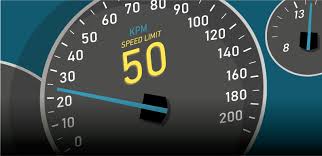
When a limiter and an IVMS are built into one integrated unit, the limiter has to keep working independently if the IVMS ever goes offline. This is not a nice-to-have — it is written into operator road safety standards.
Petroleum Development Oman’s SP-2000 Road Safety Standard, for example, requires every vehicle to carry both an IVMS and a speed limiter, and specifies that an integrated system must include a safeguard so the limiter works independently when the IVMS drops out. The logic is simple: a tracking fault on a desert lease should never quietly switch off the one control that is physically holding a loaded tanker below its rollover threshold.
GCC operator HSE speed limiter standards by company
Each major GCC operator publishes its own speed limiter and IVMS standard that sits above national law, and the differences matter when you are bidding for contracts or moving a fleet between assets. The table below is the quick view; the detail follows underneath.
| Operator | Country | Standard reference | Speed limiter + IVMS expectation |
|---|---|---|---|
| Saudi Aramco | Saudi Arabia | General Instructions (GI) / engineering standards, SAPID registration | Speed limiter + IVMS on contractor vehicles, driver authorisation |
| ADNOC | UAE | ADNOC HSE-MS aligned to OSHAD-SF Codes of Practice | ADNOC-approved IVMS + speed control for contractor fleets |
| PDO | Oman | SP-2000 Road Safety Standard | Mandatory IVMS + speed limiter, annual calibration, independence rule |
| KOC | Kuwait | 12 Life-Saving Rules, KOC Safety Passport | IVMS + speed compliance for contractor vehicles |
| QatarEnergy | Qatar | 12 Life Saving Rules, IVMS programme | Mandatory IVMS, speed monitoring, TRIR/LTIFR reporting |
| Bapco | Bahrain | HSSE-MS, contractor HSE requirements | Driving and IVMS controls under the safety management system |
Saudi Aramco speed and IVMS requirements
Saudi Aramco runs its vehicle safety through its General Instructions and engineering standards, backed by contractor registration through SAPID and a driver authorisation process. Vehicles operating on Aramco property fall under its driving rules, its citation and penalty system, and its expectation that fleets carry speed control and monitoring.
If you haul for Aramco or drive inside its facilities, the company’s own driving standard governs you the moment you are on its asset — and it enforces that with on-property citations.
ADNOC speed limiter and IVMS requirements
ADNOC manages contractor driving through its HSE Management System, which is aligned to the Abu Dhabi OSHAD-SF Codes of Practice.
In practice this is where the term “ADNOC-approved IVMS” comes from — contractor fleets are expected to fit monitoring that meets ADNOC’s transport requirements, alongside speed control, fatigue detection and journey management. For fleets working out of Abu Dhabi, ADNOC approval has become a baseline credential rather than a bonus.
PDO (Oman) SP-2000 Road Safety Standard requirements
PDO’s SP-2000 is one of the most detailed road safety standards in the region, and it is explicit about hardware: all vehicles must be fitted with both an IVMS and a speed limiter, the limiter has to be calibrated annually, and an integrated system must let the limiter run independently of the IVMS. SP-2000 goes further than the device itself, covering journey management, convoy moves, route hazard surveys, night-driving procedures, and fatigue and Ramadan driving guidance.
Tankers get their own dedicated provisions. If you can satisfy SP-2000, you are usually in good shape for the rest of the GCC.
KOC (Kuwait) Life-Saving Rules and IVMS requirements
Kuwait Oil Company anchors its driving safety in its 12 Life-Saving Rules and the KOC Safety Passport, with IVMS expected on contractor vehicles operating on its fields. Driving and speeding sit squarely inside those life-saving rules, which means an over-speed event is treated as a serious safety breach, not a minor traffic matter.
QatarEnergy speed and IVMS requirements
QatarEnergy operates its own 12 Life Saving Rules and an IVMS programme, with contractors reporting safety performance through metrics like TRIR and LTIFR. Speed monitoring feeds directly into that performance picture, so a fleet’s IVMS data becomes part of how its overall HSE standing is judged.
Bapco (Bahrain) HSSE driving requirements
Bapco — through its HSSE management system — sets contractor driving and vehicle safety expectations in Bahrain, including monitoring and speed controls under its broader safety framework. As with the other operators, the binding detail lives in the current contractor HSE requirements you are issued at prequalification.
National speed limiter regulations by GCC country
Below the operator standards sits the legal baseline, and each GCC country’s traffic authority sets its own speed limiter mandate and device-approval route. This is the layer that decides whether your truck can be registered and inspected at all.
| Country | Regulator | Governing framework | Device approval |
|---|---|---|---|
| UAE | RTA (and emirate authorities) | Federal traffic law | RTA-approved speed limiter + certificate |
| Saudi Arabia | TGA / MOI – General Department of Traffic | Road Transport Law (Royal Decree M/188) | Approved limiter, Wasl platform oversight |
| Oman | ROP / Ministry of Transport | National traffic regulations | Approved limiter + certificate |
| Qatar | MOI / Ashghal | National traffic regulations | Approved limiter + certificate |
| Kuwait | MOI – General Traffic Department | National traffic regulations | Approved limiter + certificate |
| Bahrain | General Directorate of Traffic | National traffic regulations | Approved limiter + certificate |
UAE (RTA and emirate authorities)
In the UAE, speed limiter devices are mandatory for many heavy and commercial vehicles, and the Roads and Transport Authority approves the devices used. A valid speed limiter certificate is required to pass the annual vehicle inspection across Abu Dhabi, Dubai, Sharjah, Ajman, Umm Al-Quwain, Fujairah and Ras Al Khaimah.
The two device families in common use are the Fuel Type Speed Limiter (FSL) and the Electronic Speed Limiter (ESL), both covered on the main Speed Limiter / Speed Governor page.
Saudi Arabia (TGA, Road Transport Law, Wasl)
In Saudi Arabia, road transport is regulated under the Road Transport Law (Royal Decree No. M/188), overseen by the Transport General Authority and enforced by the Ministry of Interior’s General Department of Traffic.
Compliance is backed by automated enforcement and the Wasl digital platform, which lets authorities monitor fleets for road-safety oversight. You can see the country-level detail on the Saudi Arabia page.
Oman, Qatar, Kuwait and Bahrain
Oman, Qatar, Kuwait and Bahrain each require approved speed limiters and valid certificates for heavy and commercial vehicles under their national traffic regulations, enforced by their respective traffic authorities. The country pages for Oman, Qatar, Kuwait and Bahrain lay out the local picture for each market.
Speed limiter certification and calibration requirements

A speed limiter certificate is mandatory for vehicle registration and the annual technical inspection across the GCC, and the limiter has to be re-calibrated at least once a year. The certificate proves the device is fitted, sealed and set to the correct speed; the calibration proves it is still accurate.
A few things drive a re-calibration or a fresh certificate:
- The yearly inspection cycle — calibration is checked as part of annual registration renewal.
- Engine, gearbox or tyre changes that alter how the device reads vehicle speed.
- A broken or tampered seal, which invalidates the certificate immediately.
- Operator audit requirements, where the asset owner asks for current calibration records before a vehicle is allowed on site.
Keeping these records current is not just box-ticking. On an oil field, your calibration certificate is often the document a gate auditor asks for first. You can read more about the document itself on the Speed Limiter Certificate page.
How to choose a compliant speed limiter for tanker and oil field fleets
Match the device to four fleet variables: the vehicle type, the operator standard you answer to, the number of speed zones on your routes, and whether you need IVMS data. Get those four right and the rest of the decision falls into place.
- Confirm the operator standard first. Find out whether you answer to Aramco, ADNOC, PDO, KOC, QatarEnergy or Bapco, and read their current contractor HSE requirements before you buy anything. The strictest standard sets your specification.
- Select FSL or ESL by engine type. A Fuel Type Speed Limiter controls fuel flow into the engine, while an Electronic Speed Limiter works through the vehicle’s electronic controls — the right choice depends on your fleet’s make-up, covered on the Speed Limiter / Speed Governor page.
- Use a Dual or Multi Speed Limiter for mixed routes. When a run combines highway legs with lease roads, a Dual Speed Limiter / Multi Speed Limiter lets you preset more than one governed speed.
- Use an Adaptive Speed Limiter for in-facility zones. For automatic speed drops as a vehicle enters a slower area, an Adaptive Speed Limiter ties the enforcement to GPS geofences.
- Integrate GPS and IVMS for reporting. Add a GPS tracking system so over-speed events, location and driver behaviour are logged for HSE audits.
- Add an RPM Regulator for engine protection on off-road and heavy-duty units, using an RPM Regulator to control engine revolutions and reduce wear.
- Verify certification and calibration support so the supplier can issue the certificate and handle the annual calibration without you chasing it.
Speed limiter installation and compliance process for GCC fleets
Bringing a tanker or oil field fleet into compliance takes five clear steps, from first assessment to live reporting.
- Assess the fleet and the standard. List every vehicle class, map the routes and their speed zones, and pin down which operator standard governs each contract.
- Select the right device per vehicle. Match FSL, ESL, dual, multi or adaptive control to each vehicle and route, and decide where IVMS is mandatory.
- Install and seal the device. Fit the limiter to the correct specification and set the governed speed, then seal it so the certificate stays valid.
- Calibrate and certify. Calibrate the limiter, issue the speed limiter certificate, and file the records for registration, inspection and operator audits.
- Onboard IVMS and start reporting. Connect the GPS and IVMS feed, set the over-speed thresholds and zone rules, and begin the behaviour reporting that operators expect.
When you are ready to spec a fleet or need the paperwork sorted for an operator audit, the contact page is the place to start.
Frequently Asked Questions
Are speed limiters mandatory for tankers in the GCC? Yes. Speed limiters are mandatory for tankers across all six GCC countries under national traffic law, and oil and gas operators add their own requirement for an integrated IVMS on top of that.
What is the maximum speed for a loaded fuel tanker on a lease road? Lease-road speeds for loaded tankers commonly fall between 40 and 60 km/h, though the binding figure is whatever the operator’s road safety standard and the posted signage set for that specific road.
Do Aramco and ADNOC require IVMS as well as a speed limiter? Yes. Both Saudi Aramco and ADNOC expect contractor fleets to run IVMS for driver and speed monitoring alongside speed control, as part of their HSE management systems.
How often must a speed limiter be calibrated? A speed limiter must be calibrated at least once a year, and again after any engine, gearbox or tyre change that affects how it reads vehicle speed, or if the seal is broken.
What is the difference between a speed limiter and a speed governor? There is no real difference — “speed limiter” and “speed governor” are two names for the same device that caps a vehicle’s maximum speed by controlling engine fuel or power.
Does an oil field pickup truck need a speed limiter? On most major operator leases, yes. Light vehicles such as pickups and 4x4s are caught by the same HSE driving standards as heavy vehicles, so they often need speed control and IVMS to enter the asset.
Can one speed limiter enforce different speeds in different zones? Yes. A dual, multi or adaptive speed limiter can hold several preset speeds and, when tied to GPS geofencing, drop the governed speed automatically as the vehicle crosses into a slower zone.
Country deep-dives: Oman ROP – Saudi SASO – Abu Dhabi ITC.

The Resolute Dynamics team designs and manufactures speed limiters (SLD), GPS tracking, and automotive safety systems used on 200,000+ vehicles across 20+ countries. We write about fleet compliance, road-safety regulation, and vehicle-safety technology, including Malaysia’s JPJ SLD mandate, UAE RTA rules, and global standards like UN R89, to help fleet operators and transport businesses stay safe and compliant.