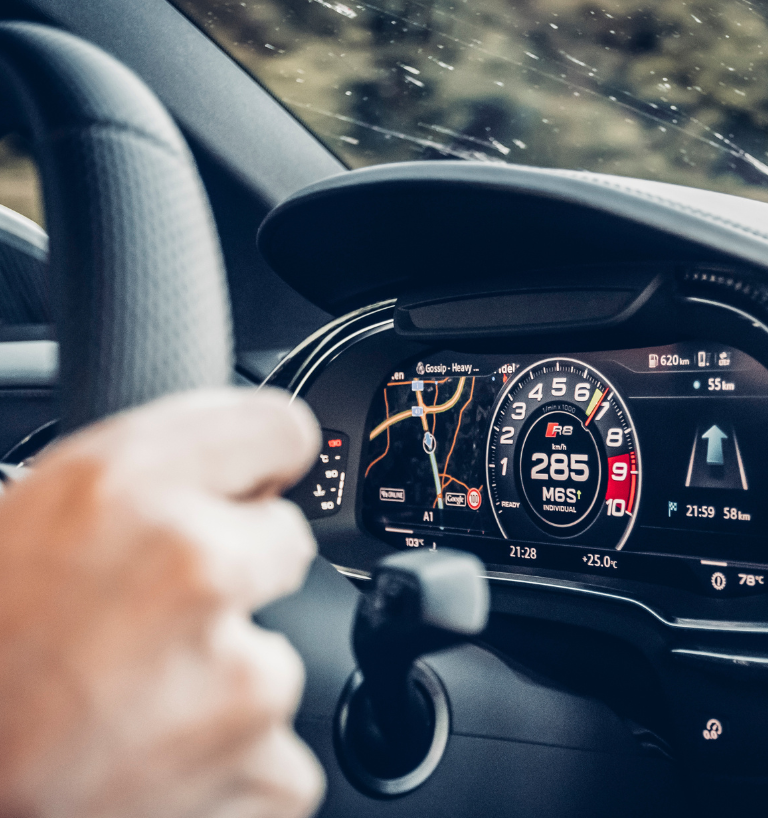
Speed decides how bad a crash will be. A speed limiter takes the top end away: the engine won’t push the vehicle past a set speed, however hard the driver presses the pedal. For trucks and buses that spend all day on public roads, that cap removes a big share of the worst outcomes.
What speed does to crash risk
The World Health Organization puts numbers on it. Every 1% increase in average speed raises the risk of a fatal crash by about 4% and the risk of a serious crash by about 3% (WHO road traffic injuries fact sheet).
The physics explains why. Braking distance grows with the square of speed, so a truck at 100 km/h needs about 1.5 times the braking distance it needs at 80 km/h. If it can’t stop in time, it hits much harder too. Heavy vehicles carry more mass, which makes the gap even bigger.
How speed limiters improve road safety
Fewer high-speed crashes
A limiter cuts off the highest speeds, which is where crash risk climbs fastest. The driver can still accelerate, overtake and cruise at the limit on a highway. They just can’t go past it.
Calmer driving
Once drivers know the vehicle won’t go any faster, most stop trying. Fleet operators usually see fewer speeding events and smoother acceleration, and fuel use tends to drop as a side effect.
Safer streets for people on foot
Pedestrians have no protection at all. According to the same WHO data, a pedestrian hit by a car is 4.5 times more likely to die at 65 km/h than at 50 km/h. Keeping buses and trucks at a safe speed near schools and work sites lowers that risk in the places people actually walk.
Which vehicles usually need one
Countries that require speed limiters tend to start with commercial vehicles. In the UAE, for example, the list covers:
- School buses
- Taxis and limousines, including airport taxis
- Passenger vans such as the Toyota HiAce, Hyundai H1 and Nissan Urvan
- Heavy goods vehicles above the weight threshold
- Tourist coaches and staff-transport buses
Speed caps and approval steps differ from one country (and one emirate) to the next. For the device itself, see our page on the speed limiter in the UAE. The speed limiter certificate page explains the inspection paperwork.
Approved devices: ECAS and the Emirates Quality Mark
In the UAE, speed limiter devices have to meet the Emirates Conformity Assessment Scheme (ECAS) and can carry the Emirates Quality Mark (EQM). The scheme used to sit with ESMA; since the 2020 government restructure, the Ministry of Industry and Advanced Technology (MoIAT) runs it. Before you buy, check that the device’s ECAS certificate is current for your vehicle category.

The Resolute Dynamics team designs and manufactures speed limiters (SLD), GPS tracking, and automotive safety systems used on 200,000+ vehicles across 20+ countries. We write about fleet compliance, road-safety regulation, and vehicle-safety technology, including Malaysia’s JPJ SLD mandate, UAE RTA rules, and global standards like UN R89, to help fleet operators and transport businesses stay safe and compliant.